The short version
Free to use. We earn nothing on the tools or local pros we point you to.
- You have two online homes that decide whether customers find you: your Google Business Profile and your Yelp page. Keep both filled in and current.
- We tested it in four cities and the two barely overlapped. Only one or two businesses showed up on both Google and Yelp each time. The customer sees a nearly different list depending on which one they open.
- New in 2026: Yelp licensed its reviews, ratings and photos to OpenAI, so ChatGPT can now pull Yelp business information into answers like "find me a good plumber near here." So your Yelp page can get you work inside AI, not just on Yelp.
- Google Business Profile still runs the map and the "near me" results on Google. It's free, and it's the first thing most people see.
- The work is almost the same for both: claim the page, fill in every field, add real photos, earn honest reviews, and reply to them.
- More reviews, a higher rating, and a complete page make both Google and AI more likely to put you near the top.
- One rule to know up front: Google is fine with you asking customers for reviews. Yelp asks you NOT to. More on that below.
Find a local AI pro
What a local AI pro actually does for your Google and Yelp pages
You can do all of this yourself. The steps are right here on this page.
But if you're on a job all day, "later" turns into never, and the profiles sit half-finished.
Here's the work a local pro can do for you.
- Looks at what you have now. Finds your Google Business Profile and your Yelp page and checks what's missing, wrong, or duplicated.
- Claims and verifies both pages. This is the step most owners have trouble with. Google may mail a postcard or call to confirm you're real.
- Fills in every field. Categories, services, hours, service area, phone, website. Categories matter more than you might think -- they decide which searches you turn up in.
- Adds real photos. Your work, your truck, your crew. Not stock images.
- Sets up a way to ask for reviews that follows each site's rules. Google is fine with you asking. Yelp asks you not to. A pro keeps those straight so your listing doesn't get flagged.
- Watches for new reviews and helps you answer them, including the bad ones.
- Connects the profiles to your website and your booking or job software, where that's possible.
- Shows you or someone on your team how to keep it going, so you're not paying for maintenance forever.
How you find one
- Put in your zip code, or tap Near me.
- Say what you need help with.
- We show you web and AI providers working in your area.
- You contact the ones you like and hire whoever fits.
It's free to find a pro through us. No signup, no email needed, and we earn nothing on it.
One thing to be clear about: we refer, we don't screen or endorse. These are independent businesses, not our employees. Check references, ask to see work like yours, and get the price in writing before you hire anyone.
Google and Yelp barely show the same businesses
In August 2026 we ran the exact same local search on both Google and Yelp in four different cities. Here is how much their top results actually overlapped.
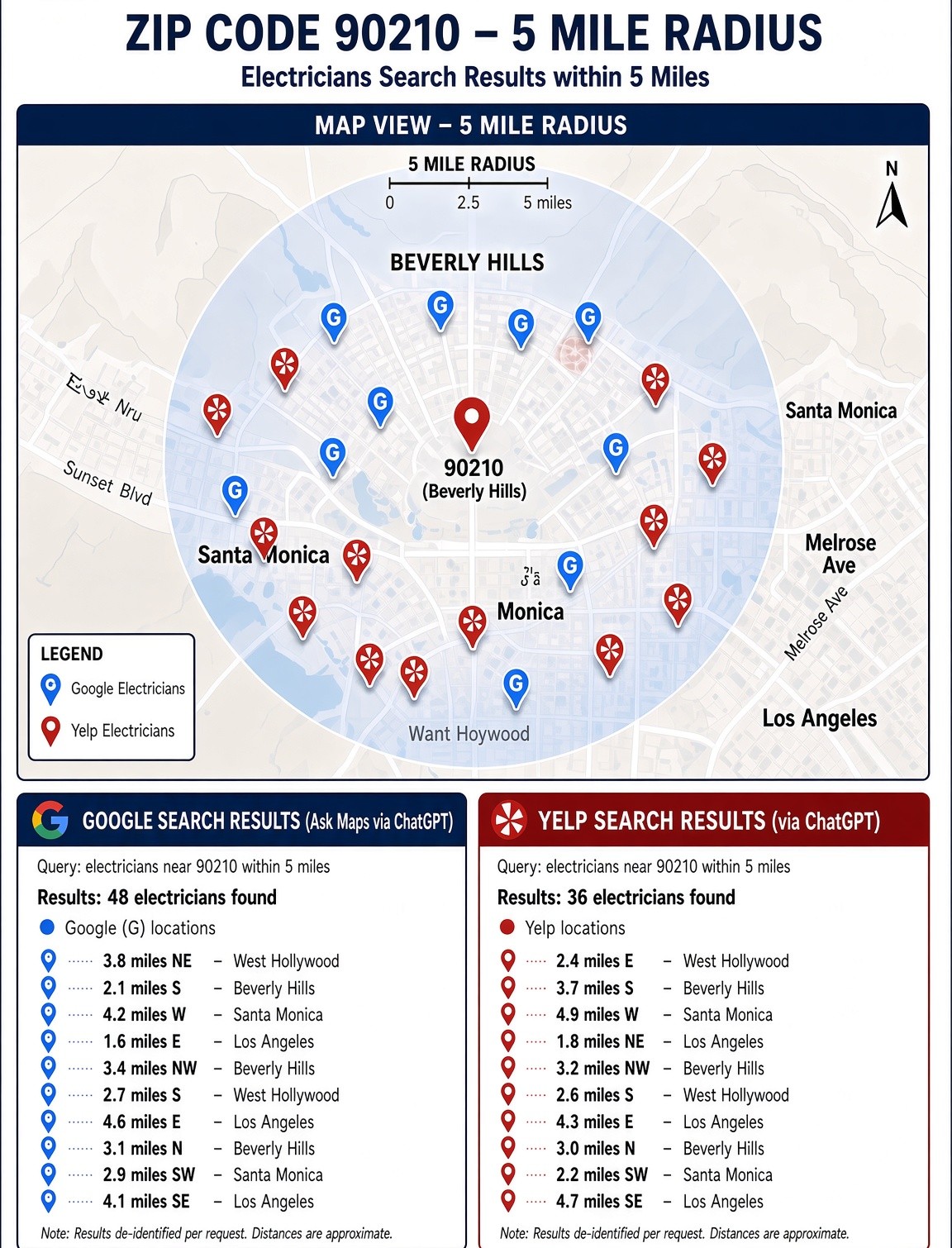
The same 5-mile search on both sites. Blue pins are the businesses Google shows; red pins are the ones Yelp shows. They rarely land in the same place. Illustration.
Read that again. In each city, only one or two businesses showed up on both Google and Yelp. Everyone else was different. So a customer who checks only Google sees a nearly different set of shops than one who checks only Yelp. If you are not set up on both, you are invisible to a whole group of people who were ready to hire.
Same business, two reputations. In one of the cities, a single electrician showed 4.8 stars from more than 2,300 reviews on Google -- but 3.7 stars from about 50 reviews on Yelp. Same company, two very different first impressions depending on where the customer looked. If a shop never claims and works both pages, one of them can quietly show a worse version of the business to everyone who checks there.
Here is why it matters more this year. ChatGPT can now pull from Yelp when it answers local questions. So the Yelp side of this split is about to reach people who never open the Yelp app at all. You can be the top-rated shop in town on Google and still get skipped when a customer asks ChatGPT -- if your Yelp page is thin.
One honest note: this is what customers see at the top of each site, not every business that exists on it. A shop can be listed on both and still rank too low to show. That is the whole point -- being listed is not enough. You have to be set up well on both.
How we tested this
In August 2026 we ran the same search on both Google and Yelp in four cities: electricians in Beverly Hills, plumbers in Austin, heating and air in Des Moines, and electricians in Tampa. Each search used the city and the zip code.
We looked at the businesses each site put at the top, then counted how many showed up on both.
That's a spot check, not a formal study. Four cities, one search each, on one day. Local results move around. They shift with where you are, what device you're on, and the day you look. Run it yourself next week and you'll probably get different names.
What doesn't move much is the size of the overlap. In every city we tried, almost none of the same businesses appeared on both sites. That's the part worth paying attention to.
Both are free to claim and free to keep. Start here:
There are also paid services like Angi, Thumbtack, HomeAdvisor, and Houzz, where you pay a fee or a cut of each job to get leads. Those work in a completely different way from these two free profiles -- we break down the costs and trade-offs on our paid lead sites page.
Think of it as two homes, not two chores
When someone needs a local business, they used to type it into Google or open the Yelp app. Now they might just ask ChatGPT. When we checked, the answers leaned on those same two places.
Your Google Business Profile is the free listing that shows up on Google and Google Maps -- your name, hours, phone, photos, and reviews. Your Yelp page is the same idea over on Yelp.
You don't have to be a marketing person to keep them working. You just have to keep them accurate. A page that's half-empty or out of date is why a ready customer picks the shop down the road instead of you.
Here's the good news: Google and Yelp reward the same habits. Do the work once and you're ahead of most local shops.
What changed in 2026, and why Yelp suddenly matters more
For years, Yelp was a place people visited on purpose. That's changing fast, and it's worth two minutes to understand why.
In the summer of 2026, OpenAI -- the company behind ChatGPT -- made a deal with Yelp. Now when you ask ChatGPT for a local business, it pulls in Yelp's reviews, ratings, and photos to build its answer. Ask it to find a contractor and it can show Yelp star ratings, quote real reviews, and link to the page. Yelp is also adding a "Request a Quote" button inside ChatGPT, so a customer can ask you for a price without ever leaving the chat.
Here's why that's a big deal for you. Yelp says it's the most-cited home services source across the major AI tools, well ahead of the next platform. That's Yelp's own number, so take it as their claim. But whether or not the exact figure holds, the direction is clear: the AI tools your customers are starting to use are reading Yelp to decide who to recommend.
So your Yelp page is no longer just a review site. It's now one of the places AI looks when it answers "who's good near me." A strong, complete Yelp page helps you show up in ChatGPT. A weak or missing one leaves you out of the conversation.
The 5 things that work on both pages
Google and Yelp reward the same habits. Do these five and you're ahead of most local shops. They're in order -- start at the top.
1. Claim the page
Both Google and Yelp may already have a listing for your business that you've never touched. Claiming it puts you in control of what people see. It's free on both.
- Search for your business on each site, then look for "Claim this business" or "Own this business?"
- You'll verify you're the owner -- usually by phone, email, or a postcard from Google.
- Until you claim it, anyone can see wrong hours or an old phone number and you can't fix it.
2. Fill in every field
Hours, phone, website, service area, categories, the services you offer, payment types. Empty fields don't just look sloppy -- when your info is missing, AI tools repeat the gap or skip you.
- Pick the most exact category you can. "Roofing contractor," not just "contractor."
- List the specific services you do, so AI can match you to the exact job a customer asks about.
- A complete page is one of the biggest things you fully control. Don't leave it half-done.
3. Add real photos
Your truck, your team, finished work, your storefront. Real photos build trust and give the AI tools something to show.
- Skip the stock images -- customers can tell, and so can the platforms.
- Add a handful to start, then a few more every month as you finish jobs.
4. Earn honest reviews (know the one rule)
Reviews are the single biggest thing that moves you up. But Google and Yelp have opposite rules about asking.
- Google: it's fine to ask happy customers for a review. Make it easy -- send them the link.
- Yelp: Yelp asks businesses NOT to ask for reviews, and never to offer anything in exchange. Yelp's software filters reviews it thinks were solicited, and asking can backfire. So on Yelp, focus on great service and let reviews come on their own.
- Never pay for reviews on either one. It's against the rules and it can get your page flagged.
5. Reply to your reviews
Answer the good ones with a thank-you and the tough ones calmly. It shows you're paying attention, and both platforms notice active owners.
- A short, polite reply to a bad review does more for the next reader than the complaint does.
- Set a reminder to check both pages once a week. A few minutes is enough.
Looking for AI tools for your trade? We keep a list for each kind of business, with real prices. Start with your group on the home page.
Google Business Profile: what's a little different
This is usually your first and biggest win, because most people still start on Google.
Set up or manage yours at google.com/business. A few Google-specific things worth doing:
Pick the most exact category you can, not a broad one. Turn on messaging if you can answer quickly. Post an update now and then -- an offer, a finished job, a seasonal reminder.
And keep your hours right, especially around holidays. Wrong hours is the fastest way to lose a call you already earned.
Yelp: what's a little different
A basic Yelp page is free. Because Yelp now feeds ChatGPT, the payoff for a strong page is bigger than it used to be.
Set up or claim yours at biz.yelp.com. Yelp will try to sell you ads on top of the free page. Ads can help, but they're optional, and a complete free page is the foundation either way.
Remember the review rule: on Yelp, don't ask customers directly and don't offer anything for a review. Yelp filters reviews it thinks were solicited, so asking can actually hurt. Instead, put the Yelp logo on your site and receipts so customers who already use Yelp know where to find you.
The upside: the same strong page can get you a customer on Yelp, on Yelp's partner sites, and inside an AI chat like ChatGPT. One page, three ways to get found.
Common questions
How this works, and how we make money
Finding a local pro through us is free. No signup, no email needed.
We don't sell the software on this page and we don't take a commission when you buy any of it. We earn nothing on the tools or the local pros we point you to.
The pros are independent businesses, not our employees. We refer, we don't screen or endorse them. Check references, ask to see work like yours, and get the price in writing before you hire anyone.
Get the exact steps for your kind of business
Want the local-search playbook built around your trade, with the situations your customers actually ask about? Start with your group.
- ▸Trades (plumbing, HVAC, electrical, roofing, and more): the local-search playbook for trades.
- ▸Professionals (attorneys, doctors, accountants, and more): the local-search playbook for professionals.
- ▸Main street (restaurants, salons, retail, cafes, fitness): the local-search playbook for main-street shops.
Find a local AI pro
Sources
- Yelp Official Blog, Yelp Brings Reservations and Waitlist to ChatGPT (August 2026).
- Axios, Yelp deal pushes local reviews into ChatGPT (July 23, 2026).
- Search Engine Land, ChatGPT gains access to Yelp reviews, ratings, and photos (2026).
- Yelp Support Center, Don't Ask for Reviews.
- Google, Google Business Profile. Yelp, Yelp for Business.